Writing and publishing a book is pleasing; nevertheless, it has its complexities, and writers who wish to have their books published must know how to navigate the labyrinth of speaking with a book publisher’s services. Traditional publishing is stagnant. However, one may be open to it as hybrid publishing, professional self-publishing, and much more open-up.
This comprehensive guide will examine the types of book publishing services provided, the benefits of using such services, information on how to choose the right publisher, processes involved in publishing a book, and outlines of costs for each category undertaken.
Types of Publishing Services
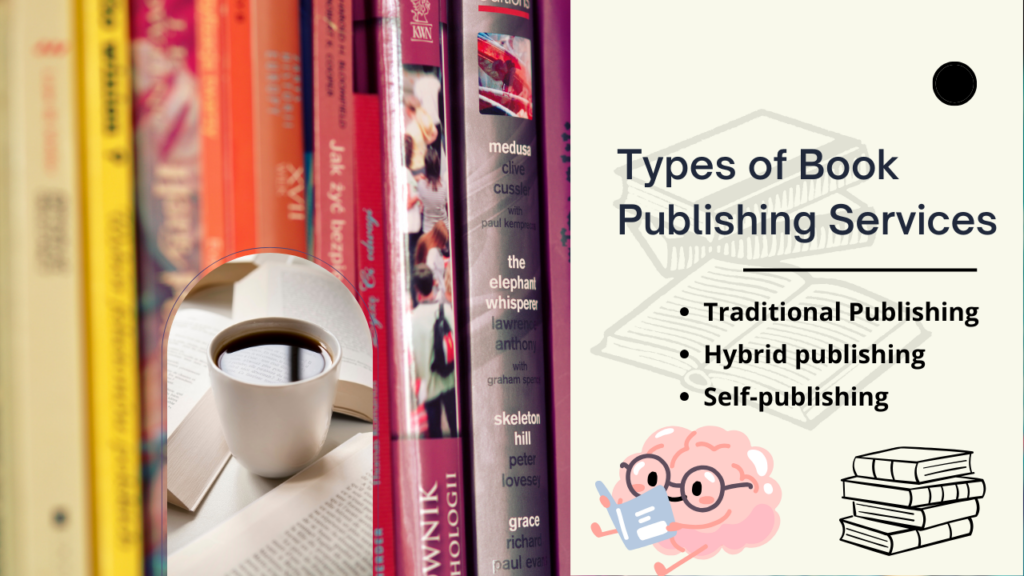
You may opt for one of three models: the traditional model, the hybrid model, and self-publishing, but having an expert in the field. Each of these three options possesses strengths and weaknesses, depending on the author’s goals, the budget allocated, and the amount of activity they are willing to participate in.
Let us explore each type in more detail:
1. Traditional Publishing
In the given situation, this model is such that the authors submit their manuscripts to various publishing houses, and the publishing house in charge is either Edit Script or Set Design. After that, they take care of all the nuts and bolts involved in that respect, including editing, designing, cover illustrations, promotions, sales prospects, and many more. In this case, more often than not, the Writer enters into an Agreement, the backbone of which is the advance payment and royalties paid afterward based on the sales of the promoted book. In this case, the only drawback is that publishing a book with one of the traditional publishers is quite puzzling and tiring.
Some of the conventional publishing include:
- Self-publishing costs: Switching writers do not make any beginning investments of their own: the publisher takes care of all the writer expenditures.
- Competence and resources: Hiring editors, designers, and promoters makes additional resources available in the company.
- Wider availability: Traditional book publishers can also penetrate bookshops, libraries, and online bookshops into use where channels of distribution to the books are embedded.
- Increased duration: The process from the manuscript’s approval to the book’s release is lengthy, from a few months to some years.
2. Hybrid publishing
Hybrid publishing gives authors the best of both worlds – self-publishing and traditional publishing. In this case, authors, in most cases, pay a little upfront for such services as editing and designing their books and marketing services but are likely to earn more from their works compared to conventional publishing, which regards authors as employees. While they claim to provide business support, hybrid publishers tend to pay authors a better percentage of royalties than traditional publishers.
Among the hybrid publishing characteristics are these:
- Joint Participation: The authors assist in financing the production, but the publisher provides the expertise.
- Reduced Timelines: The timeframe is generally less compared to the traditional method of publishing, so the authors do not have to wait too long to have their work turned into a book.
- Dominance of the Author: Authors can make decisions, almost or entirely, on images, book promotions and their contents, and other related issues.
3. Self-publishing with Professional Help
It is the perfect format for these authors because they wish to control the book’s content and cover. But are open to hiring professionals for specific tasks. Here, the author pays all the costs incurred in the whole publishing process, including editing, design, typesetting, and even advertising, only that their investment pays off since they get all royalties from the sold books. It is common for self-publishing authors to hire people for different tasks that help prepare the book for the market.
The significant features of this type include:
- Dominion of the Author: The publisher pays the author for the publication, and the author, in turn, pays the creative personnel.
- High royalties: The author pays all the costs, earning a more significant profit.
- Options: Authors have the power to choose their desired dates and methods of the ever-proposed distribution, as well as what approaches they will take to market the work.
- Costs borne by the author: Self-publishing, which does not involve external publishing houses, is costly as the Writer has to cover all the expenses related to the book’s production.
No matter what your aims and budget are and how much power over the publishing process you would want to hold, all of you will, in one way or another, choose the most reasonable publishing service that best suits you if possible.
Advantages of Professional Publishing
Working with a good book publishing service is very rewarding for first-time authors and experienced writers seeking assistance from a book publishing service. From improving the standard of your work to maximizing distribution, below are the pros of professional publishing services:
1. Expertise and Industry Knowledge
The first benefit most people gain from professional publishing is the availability of people with the necessary skills in the book industry, probably due to how long they have been practicing the business. It includes:
- Editorial support: Professional editors usually need to be engaged to polish the work so that the manuscript is formatted correctly and even pitched successfully.
- Design and formatting: The marketing team even comes in to design the book covers and layout, which enthralls the intended audience.
- Marketing and promotion: Publisher’s brands have plots and campaigns with passable contacts within the media, bookstores, and other marketing centers.
2. Access to Well-Established Distribution Channels
One of the most tricky tasks associated with publishing a book is marketing and selling the book. It includes:
- Bookstores: View publishing services through their expanse. Thus, through conventional and hybrid publishing, your book will be visible on the shelves of the top book chains and independent bookstores.
- Online platforms: Publishers will help distribute a book through websites such as Amazon, Barnes & Noble, and other major known ones.
- Libraries: Getting your book in libraries can also help you increase readers, and publishers have the connections to help you do that.
3. Trust and Promotion
Publishing through such a service can increase the value of your work. Even famous authors may agree to publish their works under a well-known brand.
- Trust with the readers increases, and readers primarily associate commercial publishing and its accompanying costs with better quality.
- Create opportunities for the author to the press: Media coverage is more likely to be sought for authors published by recognized publishing houses.
- Have a good author’s platform: Trying to enter ‘serious’ professional publishing can help shape your image as an experienced author, which will benefit future works.
4. Efficient Time Usage
Self-publishing a book is rather lengthy, too lengthy in fact, but such tasks can be cut short by professional publishers who do most of the work for you, such as:
- Project management: The publisher is responsible for coordinating and managing the whole publishing cycle, from editing, design, and typesetting to printing and distribution.
- Marketing execution: A professional publisher undertakes marketing activities, saving you time and ensuring your book reaches the right audience.
5. Money Comes Back
What’s worth highlighting is that even though professional publishing incurs costs, it can also bring some profits. Well-known publishing houses possess the means to:
- Sales maximization: Your book stands a high chance of becoming a best seller, for it has undergone professional marketing and distribution.
- Royalties: In this traditional way of publishing, books bring back royalties on sale, especially when an author is busy promoting them to the market.
How to select an appropriate publisher?
Choosing a publishing house is a crucial turning point in this self-publishing practice. When the two parties share a good relationship, the author will expect nothing less than encouragement from the reader, and you will put in place the deserving commercial efforts.
The below guidelines will increase your chances of getting a publisher who meets your needs:
- Look for an editor who works in the company that has previously published any work close to what you intend to write.
- Investigate whether the publisher has been involved in any litigation in recent times.
- Ensure that the publisher’s scope covers your area of interest – fiction, non-fiction, self-help, memoirs, and many more.
- Look at the appropriate type of literature provided by that publisher’s catalog regarding the books you want to write.
- Enquire about how they calculate the royalty rates.
- Ask how advances are structured, where necessary.
- Agree on the intervals for paying the royalties: every 3 months, every 6 months, or yearly.
- Enquire what the publisher is going to do in marketing your book.
- Discover the strategies to reach the bookshops, the libraries, and the online bookstores.
- Understand their social networking and business advertising strategies.
- Find out how much input you will get on the cover design, the title, and the content.
- Inquire whether you will be involved with pricing, distribution, and promotional methods.
- Carefully review the rights, royalties, and termination clauses spelled out.
As long as one makes an effort to research potential publishers comprehensively, one can avoid many of the intermediary’s frustrating situations and derive satisfaction from the publishing experience.
The Publishing Process

There are some things that every author should be cognizant of which are pertinent to access and use as a writer. Whether it is a self-publication or a traditional publication, here is a brief outline of the various steps to help you bring your book to the market.
The first step in this process, of course, is to deliver your manuscript for publishing in the case of such publication. In the case of conventional publishing, it is usually about getting an agent who will market your book to several publishing companies. You will hand over your manuscript to the publisher or a self-publishing site for hybrid and self-publishing.
1. Editing and Revisions
When your manuscript is accepted, the editing phase will begin. This phase consists of:
- Developmental editing: The structure, plot, characters, wording, and even pacing of the story can be improved.
- Line editing: This process examines what is and is not working at a sentence level, i.e., sentence construction, clarity, and style.
- Copyediting: Dealing with grammatical errors, use of punctuation, and spelling, among other similar errors.
2. Design, Formatting
Once the client confirms the book design, you should turn your attention now to the design and formatting of the book. It consists of:
- Cover design: Designing a cover that is attention-grabbing and appropriate to the content and mood of the book.
- Interior Layout: This includes editing and page makeup, including text, chapters, and any illustrations or images.
3. Proofreading
Before your book goes to print, it undergoes a final proofreading stage to catch any remaining typos, formatting errors, or inconsistencies.
4. Printing or digital publishing
The text of your submission should follow the basic structure of this text and be very concise in a specific area. The submission could either be packaged in a print format, as in hard or soft copies for physical distribution, or transcribed into electronic formats such as Kindle, iBooks, or iPad.
5. Marketing and Promotion
The marketing phase comes into play as soon as a book is released. The following are:
- Book launch: Engaging in book launches, online webinars, or other activities to get audience enthusiasm about the event.
- Social media marketing: Conducting target readers activities via Facebook, Twitter, or Instagram.
- Media Relations: Conducting target readers activities via Facebook, Twitter, or Instagram.
6. Distribution
The very last part is putting the book in the hands of readers. It involves:
- Dominating the book trade channels: Make sure that your book is available on sale in all major bookshops.
- Niched markets: You can distribute your book through well-known e-commerce websites like Amazon, Barnes & Noble, and many more.
- Library Marketing: Selling your book to libraries so more people are exposed to your book.
Costs & Budgeting Planning
Every author who wants their book published faces the reality of the publishing process and its unfortunate changing, as many will refer to it, of any processes that require costs. Here is a summary of the principal expenses for the working process of professional book publishing:
1. Editing Costs
Editors are indispensable but more expensive facets of the book-publishing process. Editing costs vary by type.
- Developmental editing: This type of editing targets growth aspects like the novel’s storyline, layout, and flow. The costs are flexible, starting at $1,000 and going up to $5,000, depending on the degree of duplication.
Copy editing and proofreading: It’s important to revise your manuscript to ensure that it is free of errors in grammar or punctuation. These services usually cost between $500 and $2,500.
2. Costs of Design and Formatting
The final cover, interior design, book cover design, and inside pages are covered. Costs include:
- Cover design: Custom covers cost between $500 and $2,500, depending on the book’s complexity.
Interior formatting: Desktop computer formatting for print and eBook formats will range from $300 to $1000.
3. Expenses Relating to the Marketing and Promotional Activities
No matter how perfect your artistic work is, an effective marketing strategy goes a long way toward ensuring that the book becomes a success. Promotion processes may consist of the following:
- Public relations: Outsourcing book promotions in the form of public relations and management of any other media relations, including book launches, may cost from $1,500 to $10,000.
Advertising: Managing ads on social platforms like Facebook or Amazon can cost $500 to $5,000, depending on one’s financial strength.
Book tours and events: Expenses depend on the place and specificity, but at least have a $1,000 budget for travel venues and advertising costs.
4. Additional Expenses Associated with the Book Printing
There will be additional expenses when looking at the production side of things, such as printing books. Book printing prices depend on the book length, format, and number of copies ordered. Generally, the average print costs are:
- Per-copy cost: The cost per copy of books is usually between $2 and $5 and depends on the format and page count of the book.
POD: Print-on-demand is whereby publishers print copies of books only after receiving orders. It means you do not have to print many copies simultaneously, making the printed copy slightly more valid.
5. Royalties and Distribution Fees
Again, you must factor in royalties and distribution fees with a hybrid or self-publishing. The costs differ based on the type of platform and the type of distribution:
Self-book publishing platforms:
For instance, Amazon retains a royalty on book sales (approximately 30%), unlike IngramSpark, which may impose setup fees and a distribution percentage.
Third-party hybrid publishing royalties are higher than conventional publishing models, with 50-70% royalties on net revenue commissions.
How to create a budget?
It is essential to outline a publishing plan to avoid expenses incurred and prevent such unplanned costs. Here’s what to do step by step:
Define any costs incurred, including editing, design, marketing, printing, and distribution.
Prepare for risks:
Estimate an extra 10-20 % of your budget in preparedness for emergencies.
Control your expenditure:
Monitor your expenses through budgets and software tracking throughout the publishing process.
By formulating some strategies and accounting for each expense throughout the publishing process, you will be well-positioned to advance a reasonable budget without the risk of that will overly broadening the marketing of your book.
Conclusion
Every stage is stimulating and satisfying, requiring strategies, resources, and often very complicated choices. Why look for the most reputable authors only? You have to know the differences between various book publishing services, the advantages of working with a publisher, and the stages of book publishing. Then, you can make decisions that promote the work level of your book.
If you’re ready to take the next step toward book publishing services, the right professionals will turn the tables. Look for suitable alternatives, possess a sense of fiscal responsibility, and prepare to manifest all your imaginative literature.
Upcoming Guides For Book Publishing Services
“Ever Wondered How Books Get Published? Your Publishing Roadmap”
“Understanding Publishing Contracts: What to Look For”
“The Costs of Book Publishing: A Detailed Breakdown”
“Ever Wondered How to Market Your Book? Effective Marketing Strategies”
“Ever Wondered What Editors Do? The Importance of Book Editing”
“Don’t Let Poor Design Hold Your Book Back: Design Your Book to Shine“
“Don’t Let Typos Ruin Your Book: The Importance of Proofreading”