
Step By Step Guide
Writing a book is one of the most challenging periods of the entire process, and it regards the last stretch. Whether you are writing a fiction book or a non-fiction book, the previous lap can be the hardest indeed. But using the right outlook and methods, you can complete your manuscript and fully fulfill your writing aims. This long and detailed article will help you overcome the most common barriers, keep yourself excited, and implement effective means to cross the finish line.
Let’s turn their attention to the critical tactics on How to Finish Writing Your Book and wrap up the journey that you have initiated.
Table of contents:
The Importance of Motivation
At times, toward the end of a book, a writer can begin to feel that motivation is waning. The sparkling forwardness starts to dwindle, and one will likely get stressed out looking at the amount of work still to be done. It is essential at this stage to maintain focus to achieve the primary and most challenging phase, which is writing a book.
- Reconsider Your Reasons Behind Action:
One strategy for returning one’s enthusiasm for writing is rediscovering why one became a writer. Remember what made you want to write in the first place, what idea or story you are inspired to bring to life, and what vision you meant to pursue. These may provide a fresh rationale, making you want to complete your book with the same zeal you started.
- Chunk It All Down:
If the anticipation of self-writing the long-awaited last few chapters is heavy, think of a pie chart. Rather than wait until you feel ambitious to write a few intense paragraphs, break it down into small portions of a few hundred words each or complete a small chapter at a time. Decomposing the structure in this way makes the process easier and provides a sense of achievement as one completes each piece.
- Start Well with Idiosyncratic Writings Importance:
Find a consistent behavior that lets you get into active writing well-being. It can be sitting down with coffee and needing to write, listening to specific music, or doing it at a particular time. These warm-up stages will make remembering that you must finish your book easier.
Common Obstacles And How to Overcome Them
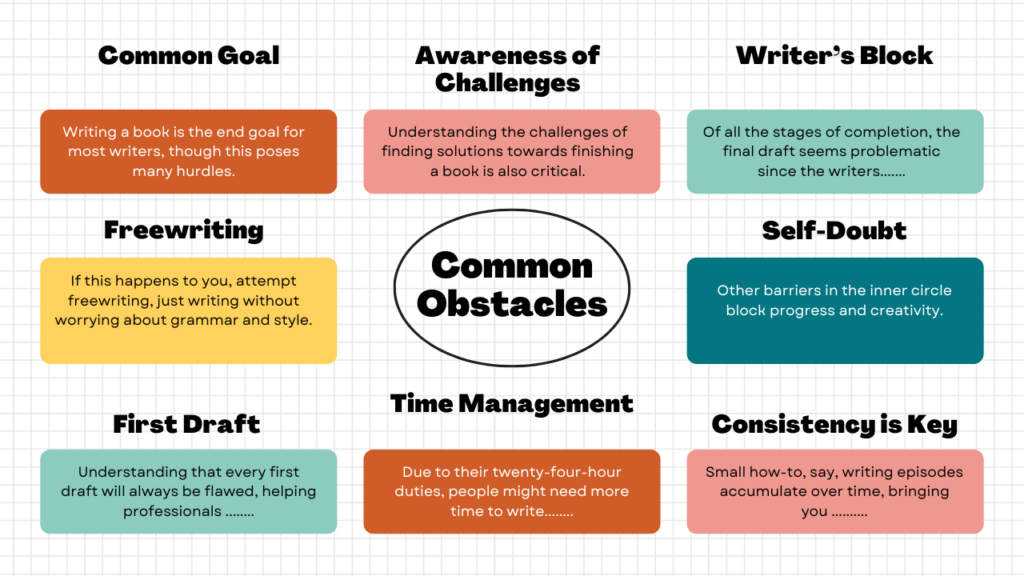
- Common Goal: Writing a book is the end goal for most writers, though this poses many hurdles.
- Awareness of Challenges: Understanding the challenges of finding solutions towards finishing a book is also critical.
- Writer’s Block: Of all the stages of completion, the final draft seems problematic since the writers are more likely to encounter problems with the plot’s conclusion or arguments than with the plot itself.
- Freewriting as a Solution: If this happens to you, attempt freewriting, just writing without worrying about grammar and style.
- Self-Doubt: Other barriers in the inner circle block progress and creativity. Self-doubt is synonymous with nearly all writers, mostly towards their final projects.
- First Draft Reassurance: Understanding that every first draft will always be flawed, helping professionals tackling your contract take care no one will expect.
- Time Management: Due to their twenty-four-hour duties, people might need more time to write; therefore, scheduling some time, particularly for writing, even if it takes half an hour a day, is necessary.
- Consistency is Key: Small how-to, say, writing episodes accumulate over time, bringing you nearer to the book’s completion.
Assigning Timelines and Using Accountability
Deadlines and any form of accountability are effective means of maintaining your concentration level to ensure that you achieve your goal of completing your novel. Here’s how to use these strategies cleverly.
- Do Not Set Unrealistic Timelines:
Deadlines create urgency and keep you on track. You can set your writing objectives in terms of daily or weekly targets depending on the pace at which you write. Make sure that the time frames outlined are realizable but still challenging. For instance, if you have an intricate chapter, expecting it to be in one day is unrealistic as the harsh timeline will only lead to inner disappointment. Instead, set a more reasonable goal of 500 words to offer firm progress movement within the day.
- Employing Accountability Tools:
If one is doing everything possible to finish writing a book, then accountability tools tend to provide a revolting factor. Some of them include:
- Writing Groups: Many people or online writing groups will be dependable since their members press each other to be on the move.
- Writing Apps: Use Scrivener, FocusWriter, or even Google Docs, which enable you to monitor your target and progress in the number of words you use.
- Mrs. A or B: Find a writer, friend, or relative who will review how far you have written and motivate you to go on.
- Treat Yourself:
Remember to motivate yourself for good work with a simple reward if you complete a deadline. Most of the time, it’s a good idea to break, buy a happy meal, or engage in any other favorite pastime. Self-rewarding helps provide positive reinforcement towards completing the task of writing the book.
The Relation to the Complementary Content
The last stage of book writing in excellence is not the only activity found in one of the several book writing processes an author goes through. To see how the entire process goes and how a person can approach and overcome writing from the beginning and manage time and tasks, Read Our Step By Step Guide: The Ultimate Guide to Book Writing. This thorough, in-depth resource is helpful for beginners and experienced writers alike, and you’ll have all the components necessary for success from the very first day.
Push Yourself and Make Sure the Book Gets Done
Finishing a book necessitates the commitment to stick to the requirements and optimally complete it, with time management techniques set in place to maintain the principles. The primary strategy is to persevere in dealing with writer’s block, keeping interest in the subject, and dealing with deadlines and other constraints. There is no time to relax even in this stage because the reward is always at the end within sight.
Conclusion

Detailed Guide For Book Writers
For detailed guidelines for book writers visit our detailed blog here: “The Ultimate Guide to Book Writing“


