
Step By Step Guide
One of the critical features in writing a novel must be the development of enjoyable and unforgettable characters. Somehow, they have a response to what the story is all about. They are the characters who provide readers with a reason to cheer, sympathize with, or even hate them. It is a practical guide that will help you avoid those mistakes and learn what it takes to create those beautiful characters that will develop your plot further. Whether you are nursing the idea of writing a book or fine-tuning an already-written manuscript, any attempt at writing compelling and believable characters will enhance your narrative skills to new levels.
Table of contents:
How to Create Realistic and Empathetic Characters
Creating believable and relatable characters has to begin with building their perspective. The readers want to link with the characters even in the highest fantasy or sci-fi worlds, making them want to walk with the characters who go through honest emotions, struggles, and development.
Establish Goals for the Character Development: Of course, just as every person has, every character also needs to have goals, desires, and lines of character disintegration. A goal is what the character drives towards, and a defect is something the audience can relate to. Regarding character development, what would motivate the main character or antagonist? For example, are they motivated by a thirst for revenge, love, or proof of superiority? It is essential not to ignore this element of the character’s goals and make sure they stem from the character’s history and can shape their behavior throughout the story.
Defects, or rather flaws, in most characters are compelling in storytelling. Whether it’s pride, self-loathing, or brashness, character flaws do make characters realistic without their perfect personas. It is this imperfection that sanitizes them as human beings. A character’s shortcomings can also lead to a resolution at the end and growth, which is not so easy to achieve.
Develop Impeccable Backs: While every character in the book has a definite past, let it not be said that all that information has to be related to the book. Rather, concentration on crafting a great backstory would help in determining the character’s present behavior. Such questions include: What events from their life must have been significant to them? How did their parents influence their current attitude? A great story background will motivate the character’s actions and behavior and will not need any explanations within the story.
Build Robust Affiliations with Other Characters: Characters do not just sit back and carry out their roles, and the interactions they build with other individuals are as important as the person’s individual characteristics. Interpersonal relationships are to create the character’s profile by depicting changes or regressions in the character. Often, the most interesting characters are those introduced in such a way that their actions and decisions impact other characters, increasing the level of emotion at stake.
Developing the Character’s Arcs
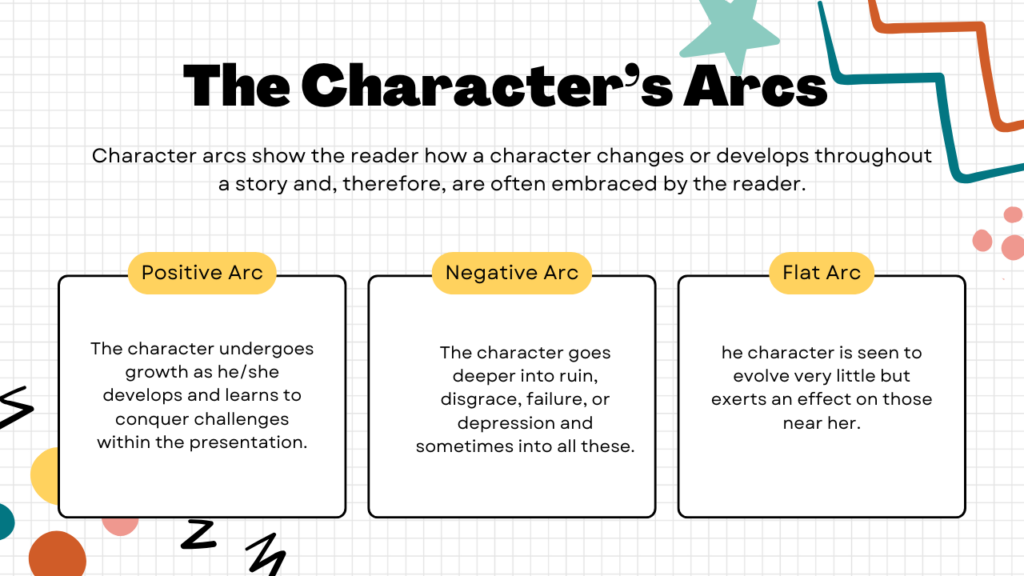
Investing in character change is critical to catching the audience’s attention and keeping it focused. Character arcs show the reader how a character changes or develops throughout a story and, therefore, are often embraced by the reader. No matter how you put it, whether a hero has to save a family or a villain has to get on the downfall, some form of character maturation and development must take place.
- Learn the Kinds of Character Arcs:
Simply put, there are three primary character arcs: 3.1 Disturbed character arcs and 3.2 Positive, negative, and flat. All of these three arcs work for a different story.
- Positive Arc: The character undergoes growth as he/she develops and learns to conquer challenges within the presentation. The main character of Voorbeeld overcomes himself at the end of the story.
- Negative Arc: The character goes deeper into ruin, disgrace, failure, or depression and sometimes into all these. Such arcs revolve around the longer time wherein the character’s insights into their life would have played a central role in ensuring that personal weaknesses do not end too tragically.
- Flat Arc: The character is seen to evolve very little but exerts an effect on those near her. These heroes never fall out of character and hold to their beliefs or ideas; for instance, a hero does not lose his integrity even when external impulses create antagonism.
- Outline the Arc with Particular Focus on the Major Plots:
For the transformation to be believable, the character’s growth from the inside must correlate with the plot’s happenings. How do events or situations within the story contrast or reinforce the character’s fundamental beliefs? If it is a positive character arc, how will other characters force the character to face the flaws and transformation by the end of the book?
Why Motivation is Important in Analyzing Characters
Motivation is vital in creating fictional elements because it helps develop the realism of the characters. Motivation answers the question of why a character undertakes the actions or makes decisions that he does. Motivation is necessary for the characters to become thin and flat to be engaging for imagined features that the audience has.
Internal vs. External Motivation: There are two kinds of motivations upon which characters depend: inner and outer. Outer motivations are ‘physical’ in nature, as they can be attained within the external environment, such as revenge, treasure, glory, and more. Inner motivations are more psychological and are self-created, such as the need for love, acceptance, or self-forgiveness.
Knowing that there is a motivation behind a character’s actions other than helping to further the story itself will help you create more exploitative characters. However, it also helps in characterization. A character may seek vengeance for the death of a loved one, which is an external reason. However, the inner purpose could be finding one’s self-worth or simply overcoming one’s fear of failure.
No More The Standard Evil Doer Antagonist: The first step is to Share a single perspective to construct the evil character. In character creation, more than creating protagonists, bring your centerpiece evil counterpart to mind if need be. Some fans hate the terrible guys, but these are not and should not be satisfying for those looking for a deeper engagement. Antagonists are central to the work; thus, authors should explain their behavior reasonably. Even ‘bad guys’ act out of reasonable motives. Preventing someone from filling oath-sworn calamities can be one of them. It encourages the reader to empathize with the villains, making them so much more than mere obstacles in the path the protagonist attempts to develop.
Linking Your Characters to the Larger Story
Having established the order of timeless characters, you need to bring a sprinkle of that marvelous depth from your novel to the overall plot or the story. How well do they contribute to the theme and message of the story? If your book is a part of the series, as in The Ultimate Guide to Book Writing, the scope of development of your characters will act as a mechanism for the following stories.
Although individual character arcs are paramount, the overall storyline should take advantage of the character’s changes over time. These characters journey for the objectives that make sense within the plot, whether they succeed or not. When accomplished, not only will your characters be remarkably unique, but they will also add to the emotional and thematic scope of the whole book.
Conclusion
Character arcs, motivations, and interactions are essential. Understanding and applying these concepts in your writing style can elevate storytelling to new heights. If the characters undergo a positive transformation, face a downward spiral, or remain steadfast in their values, their journeys must resonate with the plot and theme. Carefully aligning characters to the larger story ensures a cohesive narrative that captures the reader’s imagination and leaves a lasting impression.

Detailed Guide For Book Writers
For detailed guidelines for book writers visit our detailed blog here: “The Ultimate Guide to Book Writing“