
Step By Step Guide For Book Editors
Editing is one of the steps in writing a book that you should carefully notice and work on. Whether you are self-publishing or looking to enter the realm of traditional publishing, working on your manuscript can lead to an overwhelming debut or create an unnoticeable book. This program is to fill the gaps and articulate how to edit a book one has written. You can learn the ins and outs of self-editing when hiring an editor is advisable and what to expect from the editing process. You are sure your manuscript will be fresh and exciting to the target readers.
Table of contents:
- Step By Step Guide For Book Editors
- How to Structure Your Editing Task
- Editing Stages
- Developmental editing
- Copy Editing
- Proofreading
- Self Editing vs Hiring a Professional Editor
- Self Editing
- Hiring a Professional Editor
- Common Editing Mistakes to Avoid
- Conclusion
- Detailed Guide For Book Writers
How to Structure Your Editing Task
As reasonable as people may be, there is always a minimum of three layers of editing for every good book. Appreciating these stages will enable you to split the editing work into smaller, arbitrary portions.
Editing Stages
Developmental editing
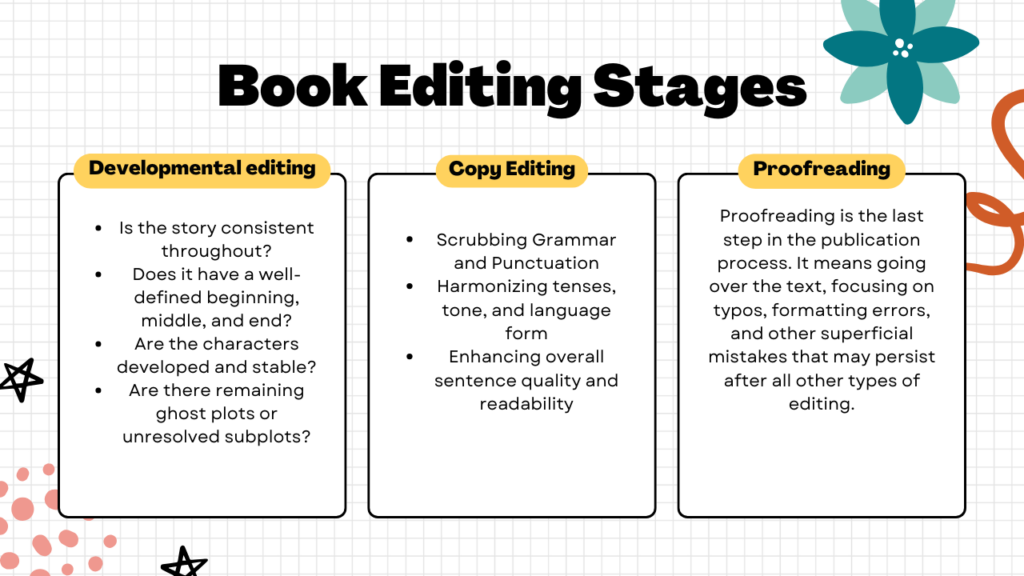
Developmental editing is the first step in improving your manuscript. This stage is concerned predominantly with the arching aspects like the plot, structure, pacing, and character growth. At this stage, you should discuss:
- Is the story consistent throughout?
- Does it have a well-defined beginning, middle, and end?
- Are the characters developed and stable?
- Are there remaining ghost plots or unresolved subplots?
About developmental editing, you may need to change or even completely rewrite specific or entire chapters or scenes. Do not be afraid to think outside the box – this is just one of the ways that writers can try to help with the most radical and pivotal changes made within developmental editing. Sometimes, you may need to alter the direction of the manuscript radically. In such a case, you will be better off letting a professional assist you with the level of editing termed developmental editing.
Copy editing
So now you feel that the book’s overall structure is satisfactory, it’s time to move on to copy editing. The area of focus during this time will be at the level of the sentences concerning grammar, punctuation, and consistency. It transforms the text to make it easier to read and maintains the same writing style for all the book pages. The following bite-sized features should have special attention while copyediting:
- Scrubbing Grammar and Punctuation
- Harmonizing tenses, tone, and language form
- Enhancing overall sentence quality and readability
As such, this is when many authors understand the relevance of making it enjoyable. Whether you are doing self-editing or have hired someone to edit your work, extra care is needed to complete a quality book at that stage.
Proofreading
The final stage of editing is proofreading, and it is usually mixed with copyediting due to a poor understanding of the two stages. Proofreading is the last step in the publication process. It means going over the text, focusing on typos, formatting errors, and other superficial mistakes that may persist after all other types of editing.
Proofreading helps ensure that your book is perfect for your potential readers. If you don’t think your proofing skills are the best, doing it will benefit you greatly.
Self Editing vs Hiring a
Professional Editor
One crucial issue every author has to struggle with is whether to self-edit or hire an editor. These methods have advantages and disadvantages, depending on your time, money, and professional skills.
Self Editing
Self-editing can be a beneficial and cheaper option for authors skilled at grammar, punctuation, and the technical aspects of storytelling. But self-editing takes work. It involves a level of discipline and objectivity that most people working closely with their work need help to achieve.
Some of the standard self-editing practices that you should practice are the following:
- Sitting back immediately and trying to edit the document is not a good idea. The best way to look at your manuscript is to edit it after a few days (weeks are best in most cases).
- Use the editing tools implemented like Grammarly or ProWritingAid and proofread for grammar errors only.
- One of the edits you can do is read the manuscript to yourself, trying to establish egregious and destructive wording or where there might be slow-moving sections.
Self-editing measures or practices can give the manuscript a good cut and shape it towards more desirable levels. Still, it is difficult to say that this approach has no disadvantages. Because you are too close to the story, it is easy to overlook obvious structural issues that lie in the story.
Hiring a Professional Editor
You can only attain the editing of a book and refinement of your manuscript towards more desirable standards by hiring a professional editor. An experienced editor helps you see things you overlook that are detrimental to your work. They can also give constructive comments that would help in this manuscript and how you write, as the feedback is on how everything is.
There are a few types of professional editing usually in need of hiring:
- Developmental Editors help to see the overall vision and offer expertise on the plot, characters, and the overall pacing of the narrative.
- Coping Editors edit the text and correct errors related to grammar and tone to deliver a well-written manuscript.
- Last but not least, Proofreaders correct any issues that you may have overlooked before printing.
While the above adds value to the book, hiring a professional editor can be pretty pricey, but it is worth the money because it increases the chances of getting the book published and read by many.
Common Editing Mistakes to Avoid
Novice writers and experienced authors need to correct common editing mistakes. Below are a few pitfalls to avoid in the editing stage.
- People who are constantly improving sometimes tend to go too far and overedit, which can destroy the core message of the writing. It is good to admit to change.
- Many editors need to consider the plot and line structure before making line edits. First, they edit the book’s structure, plot, and pacing, then move on to the language and style.
- Editing is quite draining when handled all at once, and it is even more tiring trying to edit the whole work in one clinch. It is better to take time away from the edit and remain objective and helpful in working on it later.
- Self-editing is invaluable in any writing, but it has limitations. Not hiring a copy editor means the manuscript will contain easily avoided mistakes, such as revisions and typos, that compromise the book’s quality.
- Too much editing may remove the individuality of the writing style and personality. Refrain from making alterations that will thoroughly change the book’s creative vision.
- There should not have been grammar correction where there was not enough attention and focus on issues surrounding storyline development and pacing; it was frustrating and very unproductive.
- Mistakes and bad judgment are bound to occur when one tries to rush editing by working nonstop without breaks or review.
- Without professional editing, it is realistically foreseeable that individual editing, no matter how thorough, will always have small touches you can overlook, putting the book’s reception at significant risk.
Conclusion
Editing involves many stages, from the developmental editing of your book to the final stage, proofreading. Although self-editing takes quite a long process, it is advisable to hire an editorial expert to offer you new ideas and impressions to help you craft the manuscript professionally. As such, common editing mistakes and a systematic approach to the editing process to produce a book that can retain the target audience’s attention and stand out in the market.

Detailed Guide For Book Writers
For detailed guidelines for book writers visit our detailed blog here: “The Ultimate Guide to Book Writing“